Stopping satellites
Pages in this sectionDesign and construct a chaser satellite that can hold onto a piece of space debris and pull it out of orbit.
Kit list
- Slingshot / catapult / individual who can throw
- Ping pong balls or similar objects to act as space debris.
- Craft consumables such as sticky tape, scrap paper and card, straws, pipe cleaners
- Craft tools such as scissors
- Cones or flags to mark places on the ground
Introduction
Chaser spacecraft are designed to deorbit space debris that they capture. This is done by physically pushing or pulling on the debris. In the ADR mission, once the chaser craft captures its target, it will guide it closer to Earth. This will cause a ‘destructive re-entry’, where the space debris burns up in the Earth’s atmosphere.
Designing chaser satellites that are versatile enough to capture objects of different shapes and sizes, which may be broken and tumbling wildly through space, is an engineering challenge. In this activity, you can tackle the challenge for yourself!
Set up
- Make sure you have space to safely throw the object acting as space debris.
- Gather enough craft materials for everyone taking part.
Running the activity
- Stand with enough space in front of you to throw your objects. Mark where you are standing. This point represents Earth.
- From this point, catapult or throw your piece of space debris. Mark where it lands. This is your control distance, and represents the low Earth orbit your piece of space debris is travelling in.
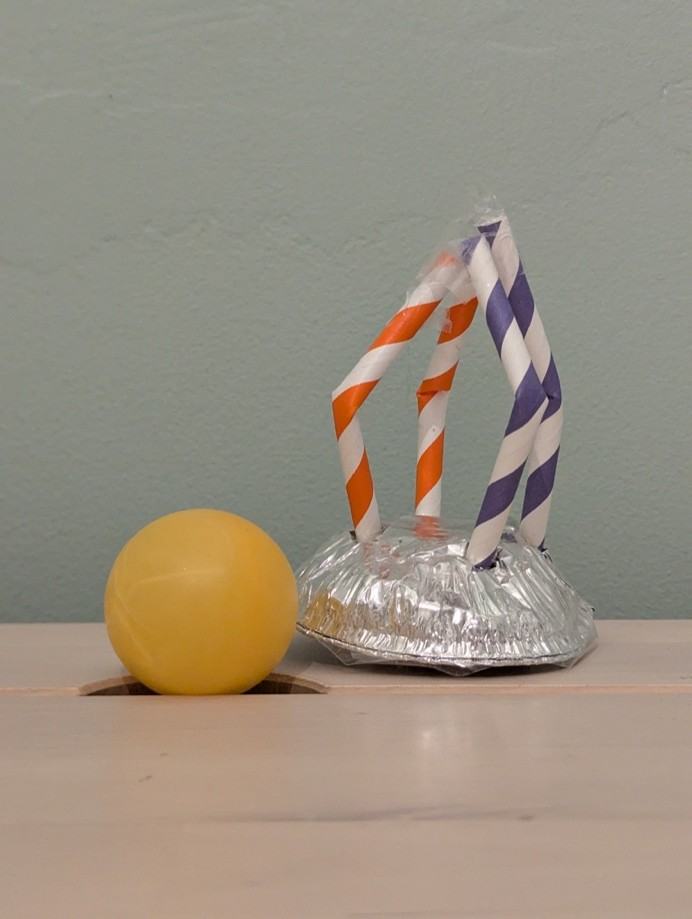
- Your challenge is to design and build a chaser satellite that can hold onto the space debris so that when it is catapulted or thrown, it does not travel as far as the control. This represents the space debris being deorbited and pulled towards Earth by your chaser craft.
- Decide what will make a successful design. For example:
- Chaser spacecraft must remain attached to the space debris.
- Include size restrictions for the chaser as they need to fit inside a rocket for launch.
- Space debris must be kept separate until just before launch as we cannot build chaser spacecraft around space debris (i.e. you can look at the debris, but don’t touch it)
- Choose a piece of space debris. For more of a challenge, choose a piece of debris, measure its dimensions, then hide it again.
- Use your craft materials to design and build a chaser craft for your specific piece of space debris. Set a time limit if you want to make this more difficult.
- Attach your chaser craft to the space debris and catapult / throw it from the original mark. If you meet the success criteria, you win!
Think about it...
What does the best chaser satellite need in its design? What can be done to make satellites easier to remove if they become defunct? What would happen to chaser satellites if they missed their target? Why would engineers need to test a chaser satellite many times before launching?
Working with groups
Turn this activity into a competition between groups. Provide each group with the same craft materials, and run the activity as before.
Competing people or teams can launch rivals’ satellites, or have a single person launch all for consistency. The winner can be decided by how many of the success criteria each chaser satellite achieves.
You can make it extra hard for the groups by only providing them with the dimensions of their piece of space debris without showing it to them. The first time they will see it is when they need to attach their chaser craft!
Destination Space extension
If your organisation took part in ASDC’s Destination Space project, use the robotic arm to communicate the chaser craft complexities further. Specifically, this can show the time delay between telling it what you want it to do and it actually doing it!
This activity is also available in our downloadable resource pack.
Header image credit: ClearSpace UK