Collision dodging
Pages in this sectionMimic our busy orbit and the risk of collisions between satellites and space junk. Can you squeeze through the gaps and avoid hitting anything?
This activity was originally developed by the European Space Agency.
Kit list
- Marbles or balls (up to 100)
- Large sheet of paper
- Marker pens or chalk
Introduction
The busier our low Earth orbit is, the more likely collisions are. Not only are active spacecraft and satellites at risk of being hit by space debris, but pieces of space debris may also smash into each other. This activity uses marbles to show how, as our orbit gets more overcrowded, it becomes more difficult to get through safely without a collision.
Set up
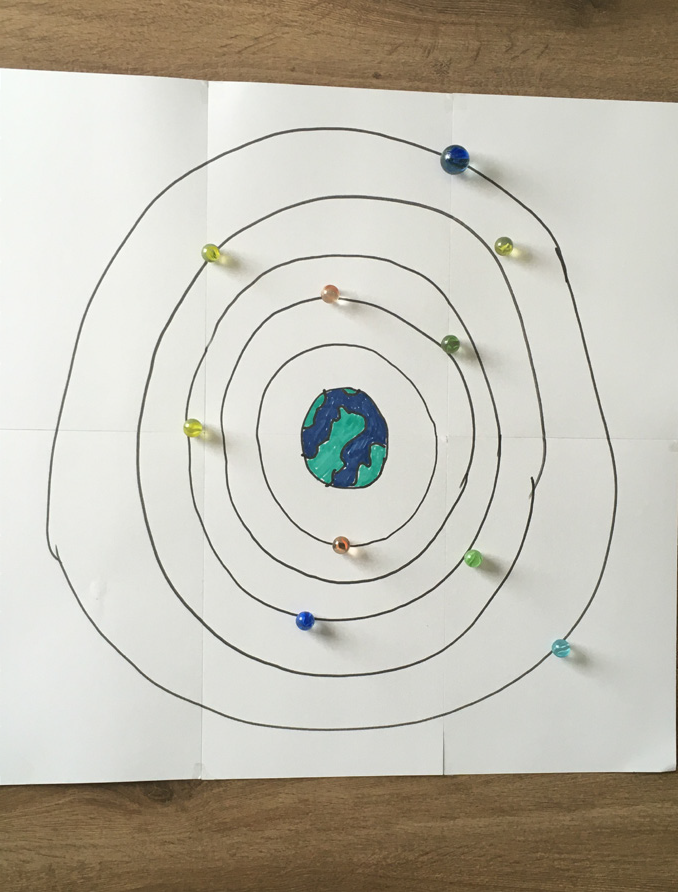
- Draw a picture of Earth in the middle of a large piece of paper or use chalk to draw it on the ground outside.
- Draw five concentric circular orbits around your Earth drawing.
Running the activity
- Place 10 of the marbles (or balls) onto your drawn circles representing orbits around Earth.
- Each marble represents an active satellite or piece of space debris. It may be useful to use one colour of marbles for the space debris, and another for the active satellites. If this is not possible you might like to draw small circles around the marbles that are ‘satellites’.
- Take another marble and, starting from outside the furthest orbit, push it across your drawing. This marble can either represent a spacecraft or satellite trying to make its way through Earth’s orbits, or a piece of space debris falling out of its orbit into others. If you want to act like a real space agent – try to avoid hitting the other marbles!
- Repeat this three times and notice what happens – does the marble you pushed hit any of the others? Does this happen every time? Is it easy to avoid hitting the other marbles?
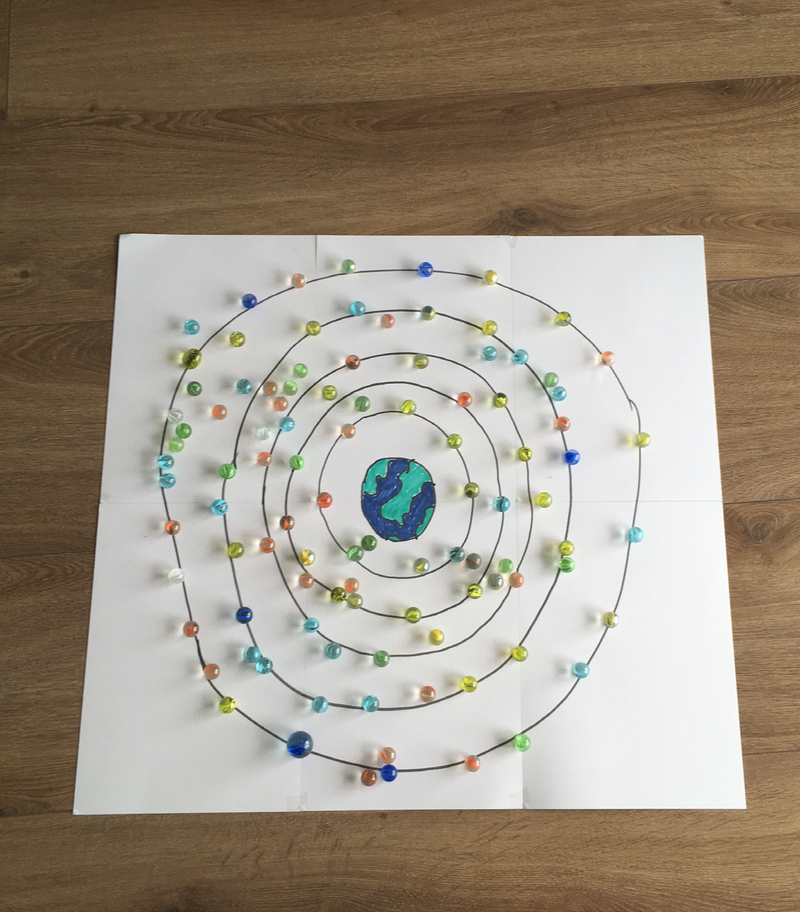
- Now put more marbles onto the different orbits and repeat what you did before, noticing the difference. Steadily increase the number of marbles, exploring at what point it becomes almost impossible to avoid them hitting each other.
- Eventually, put all your marbles (other than the three you’ll be rolling into them) onto the orbits. Is it possible to get anything through without a collision?
Think about it...
Did any marbles representing working satellites get hit? What would be the consequences if this really happened? How would that affect us on Earth?
Extension: Introducing Kessler Syndrome
When objects actually hit each other in space, any parts that fly off them also become space debris. Imagine two large objects totally destroying each other – they would smash into lots of pieces. That would produce a lot more debris. You can explore this in our next activity, Collision damage.
NASA scientist Donald Kessler theorised that if there was too much space junk in orbit it could result in a chain reaction where objects collide and create more fragments in the process, which in turn will collide with other objects. Explore Kessler Syndrome further in our Kessler Syndrome Board Game.
You can see these chain reactions of collisions happening with the marbles. However, in this demo one collision might knock a marble into other marbles. In reality, it is as if one marble collision sends out hundreds more marbles!
Top tip!
Take a before and after picture of your marbles to fully compare the impact of any collisions.
This activity is also available in our downloadable resource pack.
Header image credit: ClearSpace UK